About The WISDOM Framework™
See the whole system.
Manage the route forward.
WISDOM connects the Framework, Assess and Navigate through one journey from strategic intent to demonstrated capability.
The question behind WISDOM
The WISDOM journey began with one question.
How can leaders see whether their organisation is moving as one system?
WISDOM follows those connections across functions, governance levels and operating boundaries. It examines how evidence informs decisions, how decisions direct action and how delivery informs the next cycle.
When those links weaken, activity continues while the system begins to fragment. Priorities compete for the same resources. Decisions lose contact with evidence. Delivery drifts from intended outcomes. Learning fails to shape what happens next.
WISDOM defines that distance as The Strategic Integration Gap™. The journey starts by making the gap visible and establishing what the evidence supports.
The Framework shows how the system connects. WISDOM Assess™ establishes the current position. WISDOM Navigate™ manages the route towards stronger integration.
See the whole system. Establish the position. Manage the route.
WISDOM gives leaders one connected view of the system, the gaps within it and the route forward. It brings strategic intent, evidence, decisions, delivery and learning into the same management conversation. Leaders can then see where connection is being lost, assign ownership and test whether capability is moving towards the target state.
Giving the problem a structure
The founding question became a whole-system method.
WISDOM was developed through postgraduate research, structured design and repeated challenge.
The work drew together systems thinking, strategy, governance, enterprise risk, programme delivery, assurance and organisational learning. It examined the interfaces carrying evidence, authority, resources and feedback between them.
The research followed a complete management cycle. Evidence informs intelligence. Intelligence shapes decisions. Decisions direct resources and action. Outcomes then return evidence into the next cycle.
The Strategic Integration Gap™ describes the distance between strategic intent and consistent delivery through that connected system.
From research to application
Three connected layers answer three management questions.
The Framework defines how the system should operate. Assess establishes the current position. Navigate manages the route forward.
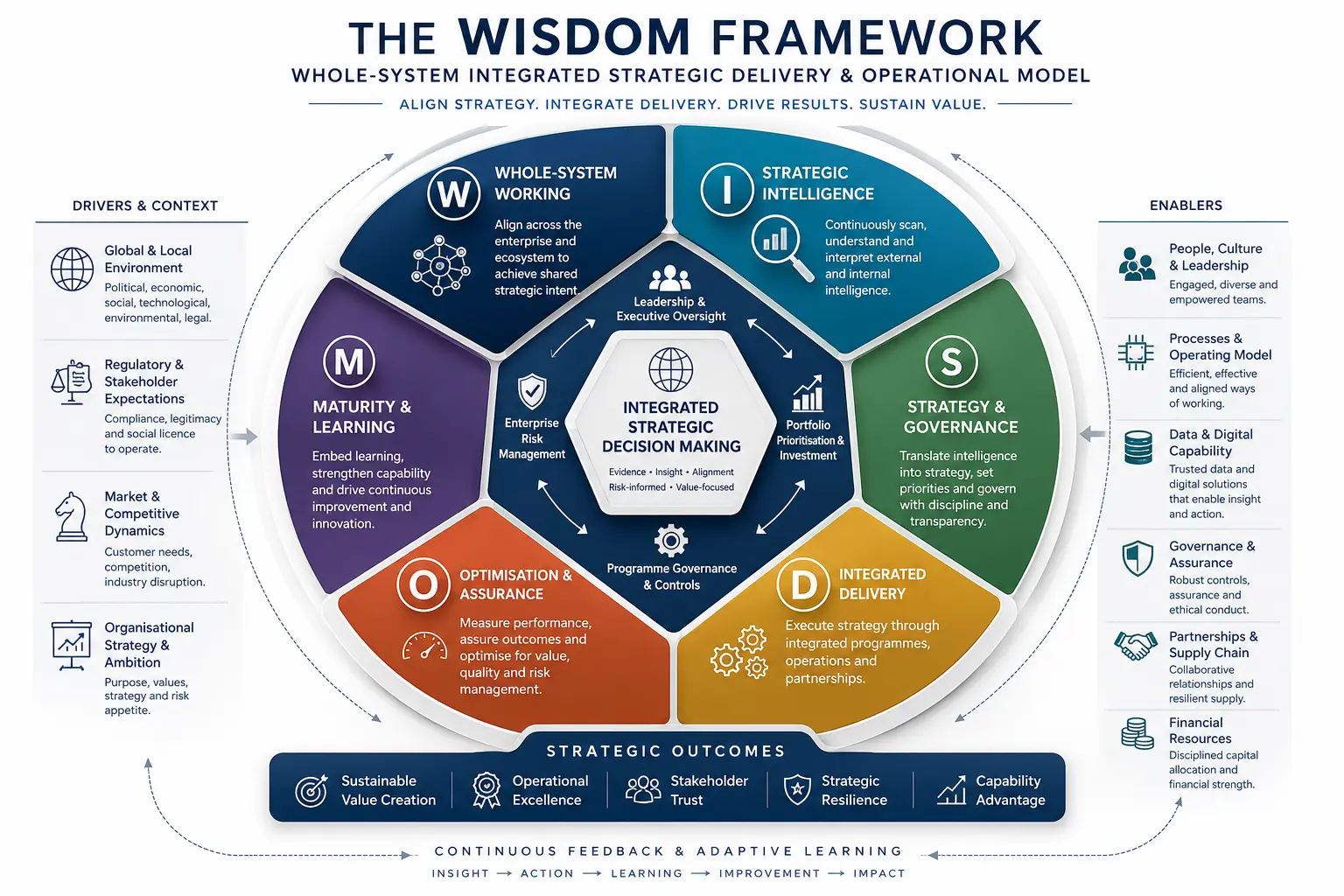
The WISDOM Framework™
The Framework establishes one operating logic across six connected capabilities. Integrated Strategic Decision Making sits at the centre.
It shows how context enters the organisation, how choices become action and how learning returns into the next decision.
- Six connected management capabilities
- Decision-centred operating logic
- One whole-system view
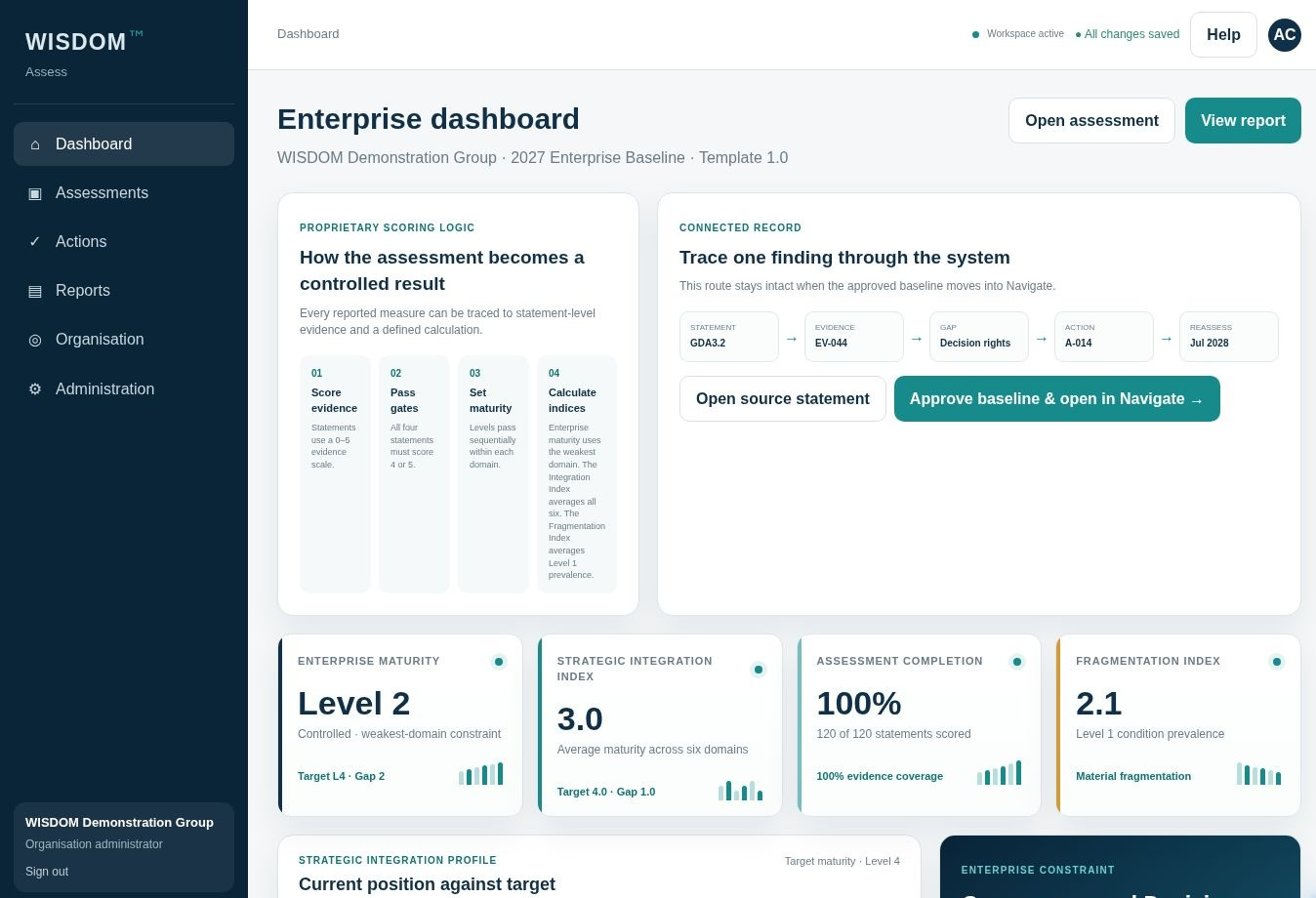
WISDOM Assess™
Assess turns the method into a controlled organisational diagnosis. It uses 120 statements across five maturity levels.
Scores remain linked to evidence, maturity gates and the organisational context behind each finding.
- 120 controlled assessment statements
- Five maturity levels
- Traceable evidence and findings

WISDOM Navigate™
Navigate carries the assessed gaps into managed delivery. Each priority can connect to actions, risks, decisions, measures and assurance.
Reassessment then shows whether the organisation has changed its underlying capability.
- Owned improvement routes
- Connected risk, decisions and assurance
- Measured movement through reassessment
What WISDOM was developed for
For organisations where delivery depends on the whole system.
WISDOM is designed for leadership teams managing complex organisations, regulated environments, enterprise change and multi-programme delivery.
It provides a common structure when priorities compete, ownership crosses functions or improvement activity loses connection with the assessed problem.
Leaders can establish the current position, agree the target state and manage the route between them.